<img height="1" width="1" style="display:none;" alt="" src="https://px.ads.linkedin.com/collect/?pid=2969948&amp;fmt=gif">

The Substitute Workforce in FocuS

2026 National Substitute Survey
Annual Report

Who Is the Modern Substitute Teacher?

We asked 18,328 of them. Here’s what they said.


Every school day, substitute teachers fill classrooms across the country. Most districts think they know who those people are. Five consecutive years of data from Red Rover’s annual substitute workforce survey says otherwise. The workforce is older, more credentialed, more purpose-driven, and more economically pressured than the conventional narrative allows, and the implications for K-12 HR strategy are significant.

Download the Full Report Download Executive Summary

Section 1:

Who’s Subbing Today?

The demographics tell a different story than what K-12 districts might think

Ask most people to imagine a substitute teacher and the profile they picture tends to skew young: a college student, a recent grad, someone filling in while they figure out their next move. Five years of data says otherwise.

chart

of substitute teachers identify as women

59%

of substitute teachers are 46 or older

30%

are between 62 and 80, the single largest age group in the survey

boxedImage

Education Level Distribution

The substitute workforce is not a waiting room for aspiring teachers. It is a seasoned, community-rooted, overwhelmingly female workforce that shows up by choice. And it is more credentialed than most districts assume.

Chart
chart_62

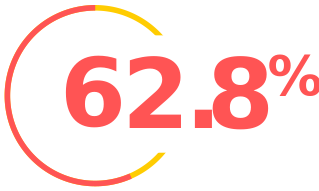
hold some form of education credential or certification

Among master’s degree holders in the pool, the vast majority are former educators. Their credentials don’t signal a career change. They signal decades of classroom experience.

Diversity Is Gradually Shifting, Too

Five years ago, White/Caucasian respondents made up 84.3% of the substitute pool. In 2026, that figure is 68.0%, a 16-point decline that has been directionally consistent every year. Over the same period, Black/African American representation nearly doubled from 5.7% to 10.5%. Hispanic/Latino grew from 2.9% to 9.3%. Asian representation more than doubled from 2.6% to 5.8%. The trend is gradual, but it is moving in the right direction.

Download the Full Report

Section 2:

Two Sub Types to Know

Career builders and community anchors require different strategies


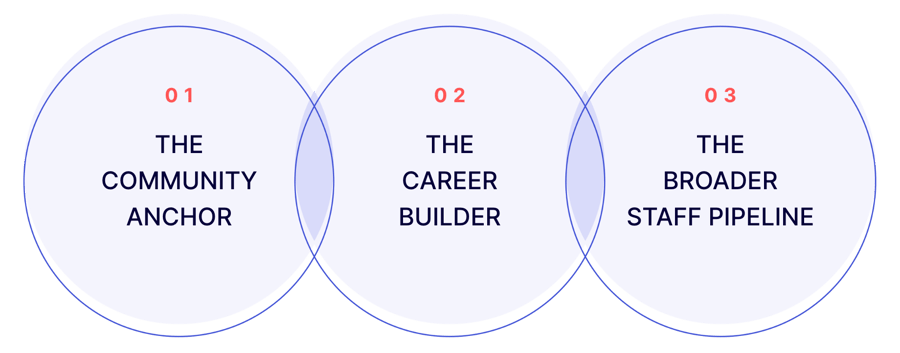
The data does not just tell us who is subbing. It reveals why. And within that why, two distinctly different substitute workforce types come into focus. Managing both as if they are the same person is one of the most common and costly mistakes a district can make. A meaningful subset of open-ended responses revealed substitutes who aren't aiming for the classroom at all, but rather using substitute work as an entry point into a school system where they hope to land permanently in roles like nursing, administration, or other staff positions.

overlappingCircles

Sub Type One: The Community Anchor (Ages 46+)

Nearly 60% of the substitute pool falls into this group. These are retired educators, retired professionals, and parents with students currently enrolled in the district. They sub for flexibility, supplemental income, and community connection. Career advancement is the lowest-ranked job factor for this cohort. Over 83% plan to continue subbing next year.

They show up ready, require minimal training, and are willing to work across grade levels and subjects. By nearly every measure, they are the highest-value, most stable segment of the substitute pool.

point

Community Anchor Sub: Key Stats

0%

plan to continue subbing next school year

0%

strongly agree or agree they enjoy substitute teaching

0%

prefer to sub 3 or more days a week

0%

would encourage a friend to try substitute teaching

Sub Type Two: The Career Builder (Ages 18-45)

teacherInClass-1

The remaining 40% of the pool tells a different story. Among 18-45 respondents, nearly 35% hope to pursue a permanent teaching credential. They rate career-building as a top job factor. Many are deciding, actively or passively, whether education is their future.

What they experience as a substitute, including the quality of support, the clarity of expectations, and the signal from the district about how much it values its people, directly influences whether they stay in the profession or quietly exit.

Career Builder Sub: Key Stats

0%

who are working toward a credential prefer to accept a permanent position at the district where they currently sub.

0%

know the steps to earn their teaching credential

0%

prefer to sub 3 or more days a week

0%

would encourage a friend to try substitute teaching

A Third Signal Worth Watching

A meaningful subset of open-ended responses revealed substitutes interested in non-teaching school roles, including nursing, administration, secretarial work, custodial positions. For this group, substitute work is a foot in the door to a school community they want to be a permanent part of. Most districts are not designed to recognize or support that transition.

Download the Full Report

Section 3:

The Needs and Gaps

The pipeline warning, the pay pressure, and the training gap

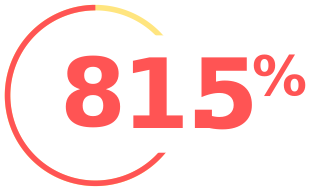
In 2026, 21% of respondents said yes to pursuing a permanent teaching credential. When you add those actively working toward one, that combined figure rises to 26.4%.

The more telling story is who is saying no, and why. Among the nearly 10,000 respondents who said no, more than 70% were never realistic pipeline candidates to begin with. Non-teaching retirees (25.8%), gig workers (22.3%), and parents with students in the district (22.1%) make up the bulk of that group. Their “no” is expected, not alarming.

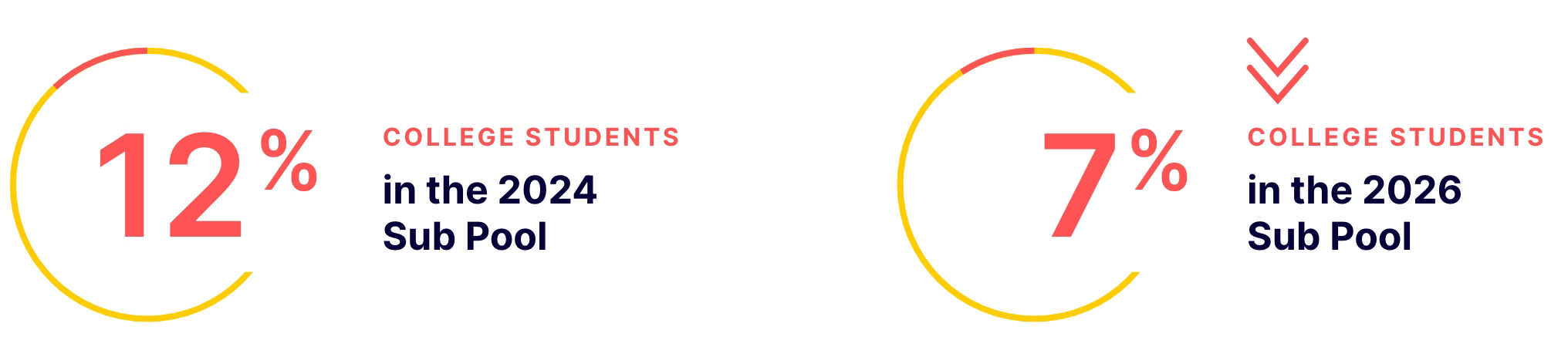
What is worth watching is the composition of the pool itself. The college student share dropped from 12% in 2024 to 7% in 2026. The overall gig worker share declined from 26% to 21% over the same period. These are the younger, more transient segments whose presence has historically correlated with pipeline potential. Their declining share is a trend to monitor.

TwoGraphs

Credential Interest Year Over Year

Credential interest: 2022: 29%, 2023: 38%, 2024: 34%, 2025: 36%, 2026: 21%.
teaching_students

Substitutes have always been motivated by purpose. In 2026, they are also increasingly motivated by pay.

Three economic indicators moved sharply upward in the same year. Together they describe a workforce that is showing up for the right reasons and asking to be compensated accordingly.

And when it comes to accepting a specific assignment, the number one deciding factor is not pay.

When lesson plans are consistently missing, substitutes notice. Districts that hold teachers accountable for providing plans and build systems to make it easy send a clear signal that the assignment is worth showing up for. This is one of the most actionable findings in the dataset.


90%

say making a difference is important or very important, a five-year high

88.6%

say reliable lesson plans are important or very important when choosing an assignment, ranking above pay

The Training Gap

chartImage

27.6% of 2026 respondents and 28.3% of 2025 respondents were never offered any training. Two consecutive years of nearly identical numbers point to a structural gap.


peopleImage

1 in 4 substitutes were never offered any training by their employer or district


The top training needs vary significantly by age group. Younger subs need classroom management support most. Older subs need technology help most. A one-size-fits-all training program serves neither group well.

One more nuance worth knowing: 35.1% of respondents said they don’t need professional development. But approximately 35% of that group are retired teachers who bring decades of classroom experience. When retired teachers are removed, 71.6% of active, non-retired subs are open to professional development. The headline number significantly understates the real appetite for training.

Download the Full Report

Section 4:

The Substitute Workforce,
Region by Region

The National Picture Only Tells Part of The Story

National averages are useful for establishing the broad contours of the substitute workforce. They are less useful for building the right strategy for your K-12 district. Segmenting the data across six regions reveals meaningfully different workforce compositions, motivations, and pressure points. What works in the Midwest will not work in the West.

Hover over the Regions for Key Statistics

Region 1: Northwest

The most pressured regional workforce in the dataset. Nearly half of respondents (49.8%) are between 18 and 45, the youngest age skew of any region. Almost 1 in 5 describe themselves as certified teachers seeking a permanent position. Plans to continue subbing sit at 68.2%, the lowest of any region by a significant margin. Retention is the most urgent challenge here.

KEY STATS:

  • 49.8% ages 18-45 (youngest region)
  • 68.2% plan to continue subbing (lowest retention)
  • 19.8% are certified teachers seeking a permanent position (highest of any region)
  • Pay importance: 85.3%

Region 2: Midwest

The most stable and most experienced regional workforce in the dataset. Nearly 1 in 4 subs have been substituting for more than six years. Plans to continue at 76.8% leads all regions. This pool is not subbing as a stepping stone. Career and healthcare importance are both the lowest of any region. Districts here benefit from low churn and deep experience.
KEY STATS:

  • 23.1% have 6+ years of experience (highest veteran share)
  • 76.8% plan to continue subbing (highest retention)
  • Credential interest: 17.5%
  • Pay importance: 84.0%

Region 3: Northeast

The most balanced region in the dataset. No single finding leads or trails other regions by a meaningful margin. Credential interest at 21.4% is close to the national figure, tenure distribution is typical, and economic pressure indicators are moderate. Region 3 districts face a broadly representative version of the national substitute workforce challenge.
KEY STATS:

  • 39.8% ages 18-45
  • 74.4% plan to continue subbing
  • Credential interest: 21.4% (close to national average)
  • Pay importance: 82.9%

Region 4: Southwest/West

The most economically pressured region in the dataset. Pay importance is the highest of any region. Healthcare importance is the second highest. The gig worker share leads all regions. For districts in Region 4, competitive compensation is not a retention strategy. It is the baseline requirement for even building and sustaining a substitute pool.



KEY STATS:

  • Pay importance: 87.8% (highest of any region)
  • Healthcare importance: 58.7%
  • Gig worker share: 26.6% (highest of any region)
  • 74.6% plan to continue subbing

Region 5: South Central

The strongest pipeline signal of any region. Credential interest leads all regions at 24.6%, and that interest is coming from newer entrants into the substitute field. The region also posts the highest enjoyment and appreciation scores of any region. Districts here have a genuine opportunity to convert substitute experience into permanent teacher hires if they invest in the pathway.

KEY STATS:

  • Credential interest: 24.6% (highest of any region)
  • Enjoyment score: 89.4% (highest of any region)
  • 75.0% plan to continue subbing
  • Pay importance: 83.8%

Region 6: Southeast

Purpose-driven and growing. Region 6 leads all regions on mission motivation. The 1-3 year cohort is the largest of any region, suggesting a pool that is relatively new but staying. Credential interest is strong at 23.8%.

KEY STATS:

  • Making a difference importance: 90.5% (highest of any region)
  • 37.5% are in the 1-3 year tenure cohort (largest of any region)
  • Credential interest: 23.8%
  • 76.5% plan to continue subbing

State Spotlights

Five states with 1,000+ responses

Texas

texas
2,421

Respondents

  • 26.8% are parents subbing in their child's district
  • 25.9% pursuing a permanent teaching credential
  • 90.6% motivated by making a difference

Michigan

michigan
2,371

Respondents

  • Gig workers (21.8%) and parents (21.6%) nearly tied
  • 21.1% have 6+ years of experience
  • 90.3% motivated by making a difference

North Carolina

northCarolina
1,831

Respondents

  • 62.8% are 46 or older
  • 76.1% plan to continue subbing next year
  • 21.5% are retired teachers

Washington

Washington
1,604

Respondents

  • 51.2% ages 18-45
  • 63.3% plan to continue subbing
  • 86.0% pay importance

Illinois

illinois
1,104

Respondents

  • Oldest pool of the top 5: 71.2% are 46 or older
  • Most experienced of the top 5: 27.0% have 6+ years
  • Highest retired teacher share of the top 5: 25.9%

Want the Full Picture?

The data on this page is a preview.

The Red Rover’s 2026 Annual National Substitute Survey goes deeper on every finding, including year-over-year trends, regional breakdowns, archetype analysis, training data, and actionable strategies for K-12 HR leaders.

Download the Full Report Download the Executive Summary

| 2026 Substitute Workforce Survey | 18,328 respondents across 46 states